Fitness
How to Choose Dumbbells as a Beginner

Updated Published
This article may contain affiliate links. If you buy through them, we may earn a commission at no extra cost to you. Read our affiliate disclosure
Fixed or adjustable? How heavy to start? A beginner’s guide to choosing dumbbells, the features worth checking, and a simple full-body routine.
On this page
Dumbbells are one of the most useful pieces of home equipment: they work every major muscle group, take little space, and last for years. For a beginner, the main questions are which type to buy and how heavy. This guide answers both. We haven’t tested specific sets, so this guide has no product rankings or prices.
Fixed versus adjustable dumbbells
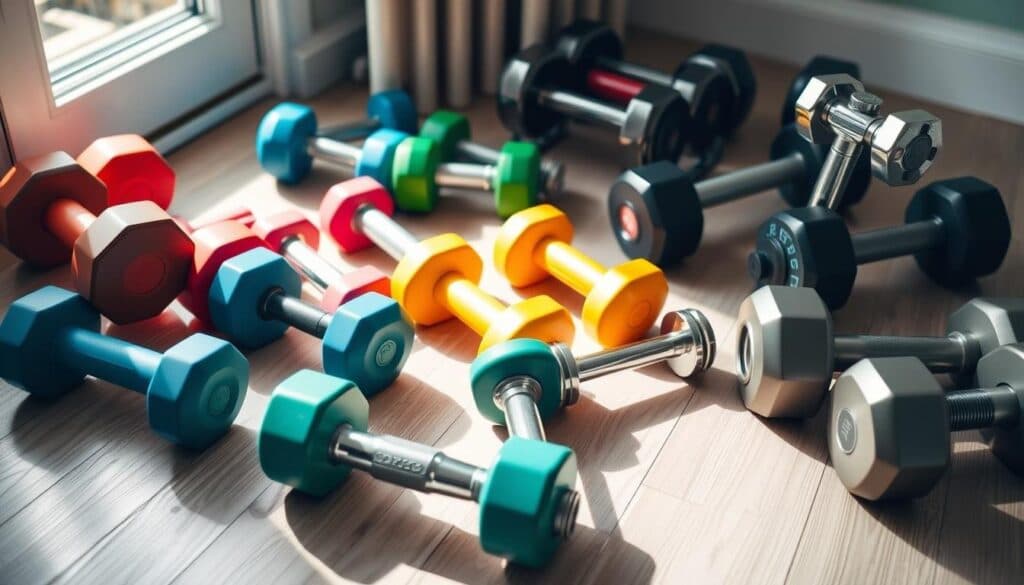
- Fixed dumbbells are a single weight each. They’re quick to pick up and very durable, but you need several pairs as you get stronger, which takes space.
- Adjustable dumbbells let you change the weight, either by adding plates to a handle and securing them with collars, or with a dial or pin system. They save a lot of space; check how quickly they change, how secure the lock feels, and whether the handle is long or bulky for exercises like presses.
- Vinyl or neoprene-coated sets are usually light. They’re fine for warm-ups and rehab-style work, but most people outgrow them quickly for lower-body exercises.
How heavy should you start?
There’s no single right number, because it depends on the exercise and your current strength. Mayo Clinic’s guidance is to choose a weight heavy enough to tire your muscles after about 12 to 15 repetitions with good form, and to increase it once you can easily do more. In practice, that means:
- Your legs and back can usually handle more weight than your shoulders and arms, so one weight won’t suit every exercise.
- That’s why an adjustable set, or two or three fixed pairs (light, medium, heavier), works better than a single pair.
- If you can’t keep good form for the last few reps, the weight is too heavy.
Features to check
- Grip: a knurled (textured) handle is easier to hold when your hands sweat; the handle should fit your hand comfortably.
- Shape: hex-shaped heads don’t roll away and are more stable for exercises where the dumbbell rests on the floor.
- Coating: rubber or urethane coatings protect floors and are quieter than bare metal.
- Storage: a small rack keeps weights off the floor and out of the way.
A beginner routine
Mayo Clinic recommends training all major muscle groups at least twice a week, with one set per exercise being enough for health benefits and a day of rest between sessions for the same muscles. A simple full-body session: goblet squat, dumbbell row, floor or bench press, Romanian deadlift, and overhead press, with one or two sets of 12 to 15 reps each. Warm up for a few minutes first, keep breathing through each rep, and stop any exercise that causes pain.
If you’re new to strength training or have a health condition, a session or two with a qualified trainer or a check with your doctor is a good investment.
Related reading
Frequently Asked Questions
Should a beginner buy adjustable or fixed dumbbells?
Adjustable dumbbells save space and money over several fixed pairs. Fixed dumbbells are quicker to switch between and very durable. Choose based on your space and how often you'll change weights.
How do I know if a dumbbell is too heavy?
If you can't finish 12 to 15 reps with good form, or your form breaks down on the last reps, it's too heavy for that exercise.
How often should beginners lift dumbbells?
At least twice a week for all major muscle groups, with a rest day between sessions for the same muscles.