Fitness
10 Workout Routines for Building Muscle

Updated Published

Discover the top 10 best muscle-building workouts to enhance strength and growth. Maximize your gains with proven routines that work fast!
On this page
Muscle-building workouts have changed a lot in recent years. They now mix efficiency with science. Fitness lovers and pros are using these new methods to get better results. Jeremy Ethier, a top fitness expert, has shared key insights on the best workouts.
Each workout is checked for its “Hypertrophy Score.” This score looks at how often and how much you work out to grow muscles. This guide will show you the top 10 workouts. They are based on the latest research and expert advice to help you build muscle fast.
Key Takeaways
- Focusing on proven routines such as 5-Day Full-Body Split and 6-Day Push/Pull/Legs Split can significantly raise your Hypertrophy Score to optimize muscle growth.
- Integrating both compound and isolation exercises within your muscle gain workout plan ensures well-rounded development.
- Implementing progressive overload and decreasing rest intervals between sets can enhance the efficiency of effective gym routines.
- Nutritional strategies like higher protein intake and calorie surpluses are critical for muscle growth.
- Prioritizing recovery through adequate sleep, supplementation, and mindful eating habits contributes to sustained muscle development.
Introduction to Muscle Building
Muscle building is getting more popular, with routines for every lifestyle and fitness level. The American College of Sports Medicine says we’ll see more workout programs based on science. These programs aim to build muscle while keeping health and sustainability in mind.
For effective muscle building, understanding key workout principles is key. Compound exercises like squats and deadlifts are best because they work many muscles at once. You can find a detailed full-body workout routine here.
Science shows that increasing weight or reps is important for muscle growth. It’s also important to do exercises correctly to avoid injuries. A common approach is to train each muscle group about twice a week.
Protein is also vital for muscle growth. Adults should eat 56 grams of protein daily, with women needing 46 grams. Getting enough calories is hard for many, due to low appetite or not knowing how much they eat.
Sticking with one plan for several weeks makes your progress easier to measure. It’s also important not to train too hard; stopping a little short of failure on most sets is a common approach.
How often you train matters too. For example, training major muscles twice a week is suggested. This includes 6 days of training with a rest day after every three days.
Workout plans are getting more flexible to meet different needs. This means more people can build muscle safely and sustainably.
Full-Body Workouts for Muscle Gains
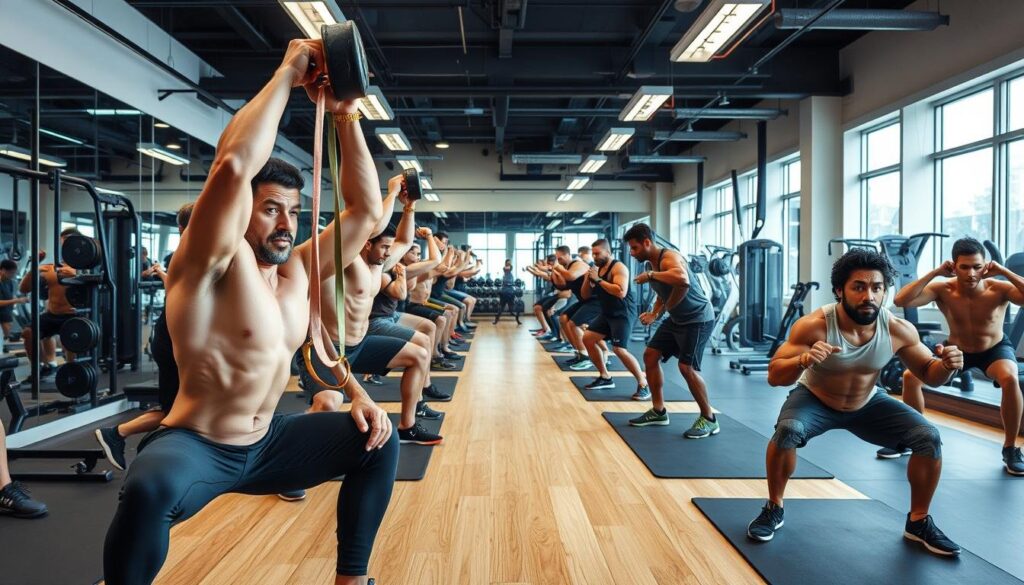
Full-body workouts are now a top choice for building muscle. They work all major muscle groups in one session. This boosts muscle growth by increasing how often muscles are worked and protein synthesis.
Example Full-Body Workout Plan
A good full-body workout for muscle building balances muscle growth and prevents overtraining. Here’s a sample plan for hypertrophy:
| Exercise | Reps | Sets |
|---|---|---|
| Dumbbell Bench Press | 6-10 | 3 |
| Dumbbell Front Squats | 10-15 | 3 |
| Dumbbell Bent-Over Row | 6-10 | 3 |
| Dumbbell Deadlift | 6-10 | 3 |
| Pike Push-Up | 10-15 | 3 |
| Face Pulls | 12-15 | 3 |
| Farmer’s Carry | 30 seconds | 3 |
This plan follows science to grow muscles every 48 hours. Keeping track of weights and reps can boost your performance.
Why Full-Body Workouts Work
Full-body workouts can be an efficient alternative to training one body part per session. They boost protein synthesis, thanks to exercises like squats and bench presses. This high-intensity, high-volume approach develops major muscle groups and improves coordination and performance.
Full-body training also promotes muscle balance and prevents injuries. Adding corrective exercises and changing rep ranges in a muscle building workout plan maximizes growth. A 3-day full-body split also manages energy and supports steady muscle growth.
Effective Push/Pull/Legs Split
The push-pull workout routine is a favorite for those looking to build muscle and strength. It divides major muscle groups into three days, giving each group enough time to recover. Here’s how it works:

Push Day: This day focuses on the chest, triceps, and shoulders.
- Chest: Use bench press and flyes for great results.
- Shoulders: Do overhead press and lateral raises for strength and definition.
- Triceps: Tricep dips and extensions are key for engagement.
Pull Day: This day targets the back and biceps, complementing the push day.
- Back: Pull-ups, rows, and deadlifts are essential.
- Biceps: Focus on curls and chin-ups for strength and size.
Leg Day: This day focuses on the lower body, including quads, hamstrings, and calves.
- Quads: Squats and leg presses are important.
- Hamstrings: Use hamstring curls and Romanian deadlifts.
- Calves: Add calf raises to finish the session.
The 6-day muscle-building split is for more experienced lifters. It’s a variation of the routine, designed for those who have been lifting for a while. Here’s how it’s organized:
| Day | Workout |
|---|---|
| Monday | Push |
| Tuesday | Pull |
| Wednesday | Legs |
| Thursday | Push |
| Friday | Pull |
| Saturday | Legs |
| Sunday | Rest |
This 6-day split offers flexibility for different goals and experience levels. It allows for adjusting exercise selection and training intensities. This way, both intermediate and advanced lifters can get the most out of it.
One drawback of the three-day push-pull routine is that each muscle group is trained only once a week. This might require more sets. But the six-day split fixes this by training each group more often. It balances training volume and recovery for muscle growth.
Strength Training for Muscle Growth
Strength training is key for growing muscles. It uses both compound and isolation exercises to work on different muscle groups. Increasing weight, frequency, or intensity helps muscles get stronger and grow.
Compound vs. Isolation Exercises
Compound exercises like deadlifts and squats work on many muscles at once. They increase metabolic demands and exhaust muscles more. For example, squats work the legs and core, boosting lower body strength.
Bench presses target the chest, shoulders, and triceps, important for upper body strength. Overhead presses help build shoulders and upper body strength.
Isolation exercises focus on specific muscles. Bicep curls, for instance, work only the biceps. This is key for balanced muscle growth.
Progressive Overload Techniques
Progressive overload exercises help muscles adapt and grow. This means gradually increasing workout weights or intensity. Barbell exercises, like the 5×5 program, stimulate many muscle fibers and boost testosterone.
Techniques like German Volume Training and the FST-7 program also aim for muscle growth. They increase nutrient delivery and metabolic stimulation.

Training at least three days a week is best for muscle growth. It’s important to balance upper body workouts with progressive overload exercises. Deadlifts and rows are key for the back, while squats and bench press are essential for overall development.
Keeping proper form and technique is vital. Diverse training programs and balanced muscle work help grow strength and muscle effectively.
Best Muscle-Building Workouts
Choosing the right workout routine is key to building muscle. The 5-Day Full-Body Split, 6-Day Push/Pull/Legs Split, and Upper/Lower/Push/Pull/Legs Split are top choices. They help with recovery and muscle growth.

5-Day Full-Body Split
The 5-Day Full-Body Split is great for muscle growth. It targets all major muscle groups several times a week. Many training plans work each muscle group two or three times a week.
Each workout focuses on different muscles. This ensures balanced growth and recovery.
-
Recommended schedule:
- Day 1: Chest and triceps
- Day 2: Back and biceps
- Day 3: Legs
- Day 4: Shoulders
- Day 5: Rest or active recovery
- Sets and reps: 3-4 sets of 8-12 reps per exercise for hypertrophy
- Progressive overload: Increase weight or reps each week to avoid plateaus
6-Day Push/Pull/Legs Split
The 6-Day Push/Pull/Legs Split is perfect for advanced lifters. It focuses on specific muscle groups. This ensures each muscle gets enough attention for significant gains.
- Recommended schedule:
- Day 1: Push (chest, shoulders, triceps)
- Day 2: Pull (back, biceps)
- Day 3: Legs
- Day 4: Push
- Day 5: Pull
- Day 6: Legs
- Day 7: Rest
- Ideal workout volume: 3-4 sets of 8-12 reps
Upper/Lower/Push/Pull/Legs Split
The Upper/Lower/Push/Pull/Legs Split offers a balanced approach to muscle training. It suits lifters at all levels. This split is flexible and can be tailored to individual needs and goals.
- Recommended schedule:
- Day 1: Upper body
- Day 2: Lower body
- Day 3: Push
- Day 4: Pull
- Day 5: Legs
- Day 6: Rest or active recovery
- Important tips: Maintain proper form and technique for maximum benefits
Resistance Training for Beginners
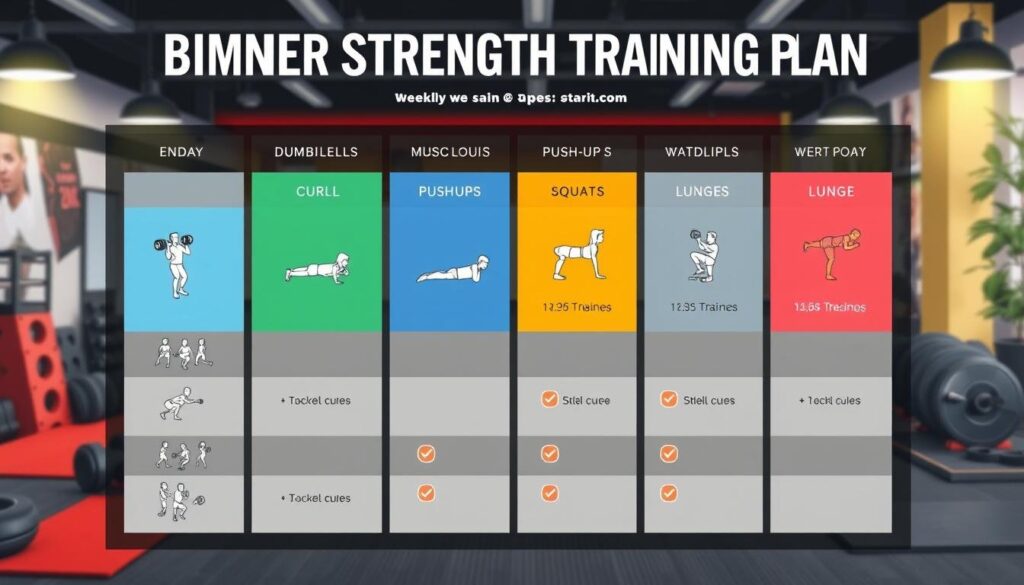
Starting a new fitness journey? Resistance training is key for building muscle and fitness. A good beginner strength training plan helps you progress safely and effectively. Let’s explore the essential exercises and form tips for beginners.
Essential Exercises for Newbies
For beginners, starting with basic exercises is important. These exercises help build muscle and strength. Here are some key ones:
- Squats: A powerful lower body muscle-building exercise that targets the quadriceps, hamstrings, and glutes.
- Bench Press: An upper-body staple, engaging the chest, shoulders, and triceps.
- Rows: Effective for strengthening the upper back and biceps.
Start with bodyweight versions of these exercises. This helps beginners learn proper form before adding more resistance.
Form and Technique Tips
Proper form and technique are vital for a successful muscle building workout for beginners. Here are some tips to help you:
- Focus on Alignment: Keep your spine neutral, shoulders back, and core engaged.
- Control Your Movements: Avoid using momentum. Instead, practice controlled and deliberate motions.
- Breathe Effectively: Exhale during exertion and inhale during the relaxation phase of each exercise.
- Gradual Progression: Start with lighter weights and increase gradually as you become more comfortable and proficient with each exercise.
Following these tips makes your workouts more effective and safe. Remember, mastering the basics is the first step to more advanced training.
Advanced Muscle-Building Techniques
Using advanced muscle-building techniques can really help you grow your muscles, even if you’re already experienced. This part talks about three key methods: high-volume training, time-under-tension workouts, and using the best gym machines for muscle growth.
High-Volume Training
High-volume training means doing lots of sets and reps. It makes your muscles work harder, which helps them grow. A study in Sports Medicine found that it boosts muscle growth by increasing tension, damage, and stress.
Adding high-volume training to your routine can really change the game for you.
Time Under Tension Workouts
Time-under-tension workouts make your muscles work longer in each set. This increases stress on the muscles, helping them grow. Many lifters use it to make lighter weights more challenging.
It’s also great for getting the most out of your workouts in less time.

Utilizing Gym Machines for Growth
Gym machines are great for growing muscles because they target specific areas well. The best gym machines for muscle growth offer stability and controlled movements. This makes high-intensity training safe and effective.
Machines like the leg press, chest press, and lat pulldown can help you gain muscle fast. They focus on specific muscles and are safer than free weights. Plus, they’re perfect for drop sets, which can triple muscle size gains.
| Training Technique | Benefits |
|---|---|
| High-Volume Training | Increases total workload and stimulates greater muscle growth |
| Time Under Tension Workouts | Enhances muscle stress and promotes hypertrophy |
| Utilizing Gym Machines | Targets specific muscle groups with precision; reduces injury risk |
Importance of Recovery in Muscle Building
Proper recovery is key for muscle growth. Without enough rest, muscles keep breaking down. This can slow your progress.
It’s important to take two to three days off each week. These days should include gentle activities like yoga or walking. This helps your muscles repair and rebuild.

Growth days help you perform better. They give you time to rest and recover before big challenges. This increases your chances of success.
Supplements can also help with recovery. Coenzyme Q10 fights inflammation and supports cell recovery. Citrulline is good for older adults, helping with muscle loss.
Eating more protein is also essential. Whey protein is better than casein for muscle soreness. It helps reduce delayed onset muscle soreness (DOMS).
| Supplement | Benefit |
|---|---|
| Coenzyme Q10 | Reduces oxidative stress and inflammation, enhances recovery |
| Crocodile Blood | Maintains muscle force and reduces DOMS |
| Whey Protein | Increases leucine concentration, reduces muscle soreness |
| Vitamin D | Reduces proinflammatory cytokines, aids in inflammation control |
It’s important to tailor rest to your fitness level. Beginners need more time to recover. Regular exercisers might need less. Remember, recovery days are vital for muscle growth and avoiding overtraining.
Conclusion
Building muscle needs a smart plan based on science and your fitness level. It’s important to mix up your workouts with both big movements and smaller ones. This mix helps grow muscles well.
Doing exercises that work many muscles at once is key. Aim for at least three workout days a week. Each day should have hard workouts with 2-4 sets for each muscle group.
Using the best exercises for muscle growth is essential. These exercises work many muscles at once. Adding more weight over time is also important for muscle growth.
A 3-day split routine is a good example. It includes full body workouts on Monday, Wednesday, and Friday. This is great when you’re short on time. It makes sure all muscles get worked.
If you can’t go to the gym, you can build muscle at home. Focus on basic movements and use your body weight or little equipment. Mix big exercises like push-ups and squats with smaller ones to target specific muscles.
It’s all about balance and how much you work out. This balance helps muscles grow and stay fit. With the right workouts and rest, reaching your muscle-building goals is possible.
FAQ
What are the best muscle-building workouts for rapid gains?
For quick muscle gains, focus on workouts that are consistent and increase in intensity. Try the 5-Day Full-Body Split, 6-Day Push/Pull/Legs Split, or Upper/Lower/Push/Pull/Legs Split. These plans balance your workouts and rest well.
How should beginners start with resistance training?
Start with basic exercises like squats, bench presses, and rows. Make sure to learn the right form first. Beginners should use a plan with lighter weights and more reps.
Why are full-body workouts effective for muscle building?
Full-body workouts work all major muscles at once. This means you train more often and build muscle faster. Exercises like squats, bench presses, and deadlifts make each session count without overdoing it.
What is the Push/Pull/Legs split and who should use it?
The Push/Pull/Legs split divides workouts into three types. This helps you recover and focus on specific muscles. It’s great for those who have been lifting for a while, as it fits well into a busy schedule.
What techniques support continuous muscle growth?
To keep growing muscle, use progressive overload, high-volume training, and time under tension. Increasing weight or intensity helps muscles adapt. More reps and tension stress muscles, leading to growth.
What are essential exercises for beginners in strength training?
Beginners should start with compound exercises like squats, bench presses, rows, and deadlifts. These exercises work many muscles at once. Focus on proper technique to avoid injuries and get the most out of your workouts.
How does increased protein intake affect muscle growth?
More protein is key for muscle repair and growth. It helps your muscles recover and build back stronger. Eat protein-rich foods like lean meats, dairy, and plants to support muscle growth.
What are the benefits of using gym machines for muscle building?
Gym machines offer targeted training that helps isolate muscles and boost growth. They’re good for high-volume workouts and keeping form right. Machines also lower injury risk.
Why is muscle recovery important in a workout routine?
Recovery lets muscles fix and grow after exercise. Without enough rest, you risk overtraining and injury. Rest days, stretching, and enough protein are key for recovery.
How do progressive overload exercises help in muscle building?
Progressive overload exercises make muscles work harder, leading to growth. Increase the weight, reps, or workout intensity. It’s a key principle for getting stronger over time.