Fitness
Home Gym Equipment for Small Spaces: What You Actually Need

Updated Published
This article may contain affiliate links. If you buy through them, we may earn a commission at no extra cost to you. Read our affiliate disclosure
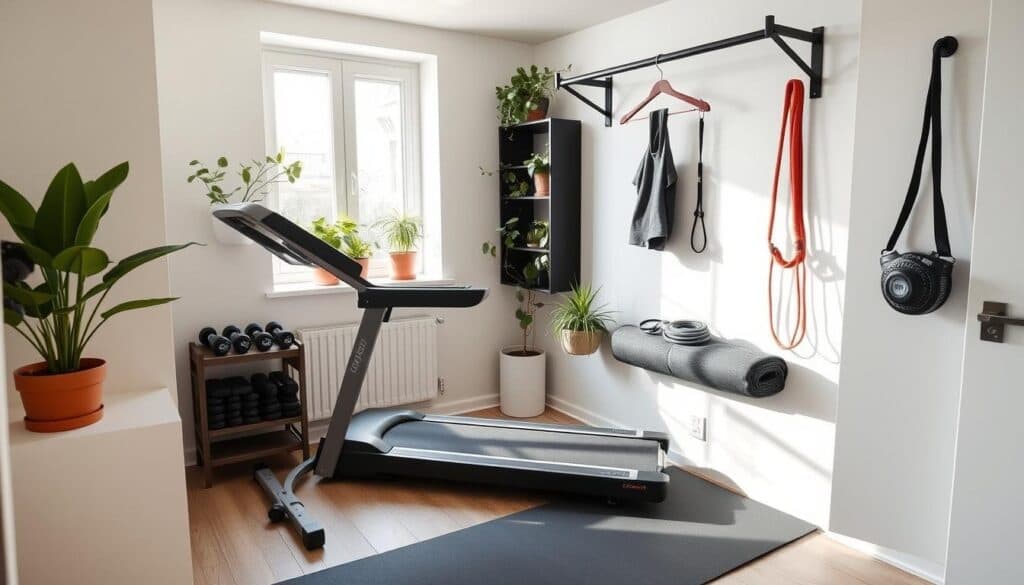
What to buy for a home gym in a small space, in order of priority: mat, resistance bands, adjustable weights, and how to judge larger equipment before you buy.
On this page
You don’t need a spare room to train at home. A small set of versatile equipment covers strength, cardio, and mobility in the space of a yoga mat. This guide explains what to prioritise, in what order, and how to check that each piece suits a small home. We haven’t tested specific brands, so this guide has no product rankings or prices.
Start with what you need to train
For general health, adults should aim for at least 150 minutes of moderate activity a week and muscle-strengthening work for all major muscle groups on at least two days a week (CDC). Mayo Clinic notes that bodyweight exercises, resistance tubing, and free weights all build strength, so a small home gym can cover the strength side with very little kit.
The core kit, in order of priority
- An exercise mat: for floor work, stretching, and core exercises. It also marks out your training space.
- Resistance bands: light, cheap, and they fit in a drawer. Loop bands and tube bands with handles cover most of the body.
- Adjustable dumbbells or one or two kettlebells: the most space-efficient way to add load once bodyweight work gets easy.
- A jump rope: for cardio, if you have the ceiling height and floor space, and neighbours who won’t mind the noise.
- A doorway pull-up bar: optional; check that your door frame is the right type and solid enough before buying.
Larger items: only if you’ll use them
A bench, a compact bike, a rower, or a folding treadmill can make sense if you know you’ll use them several times a week. Before buying, measure the floor space with the machine open and folded, check the maximum user weight, and think about where it will live when you’re not training.
How to judge equipment for a small space
- Storage: can it go under a bed, in a cupboard, or on a wall hook?
- Versatility: how many exercises does it allow? A pair of adjustable dumbbells replaces a rack of fixed weights.
- Noise and floor protection: rubber-coated weights and a mat underneath protect floors and reduce noise.
- Adjustability: you’ll get stronger, so equipment that can increase resistance lasts longer.
A simple routine to start
Mayo Clinic suggests choosing a weight or resistance that tires your muscles after about 12 to 15 repetitions, and resting a day between sessions for the same muscle group. A short session could be: squats, push-ups (on the wall or knees if needed), band rows, dumbbell or kettlebell deadlifts, and a plank, done once or twice through. Warm up first with a few minutes of brisk walking or marching on the spot.
If you have a chronic condition or haven’t exercised in a long time, check with a healthcare professional before starting.
Related reading
Frequently Asked Questions
What is the first thing to buy for a home gym?
An exercise mat and a set of resistance bands. Together they cover a full-body routine for very little money and space.
Are adjustable dumbbells worth it in a small space?
Usually yes: one pair replaces several fixed pairs. Check how quickly the weight changes and how secure the locking mechanism feels.
How often should I strength train at home?
The CDC recommends muscle-strengthening activity for all major muscle groups on at least two days a week.